


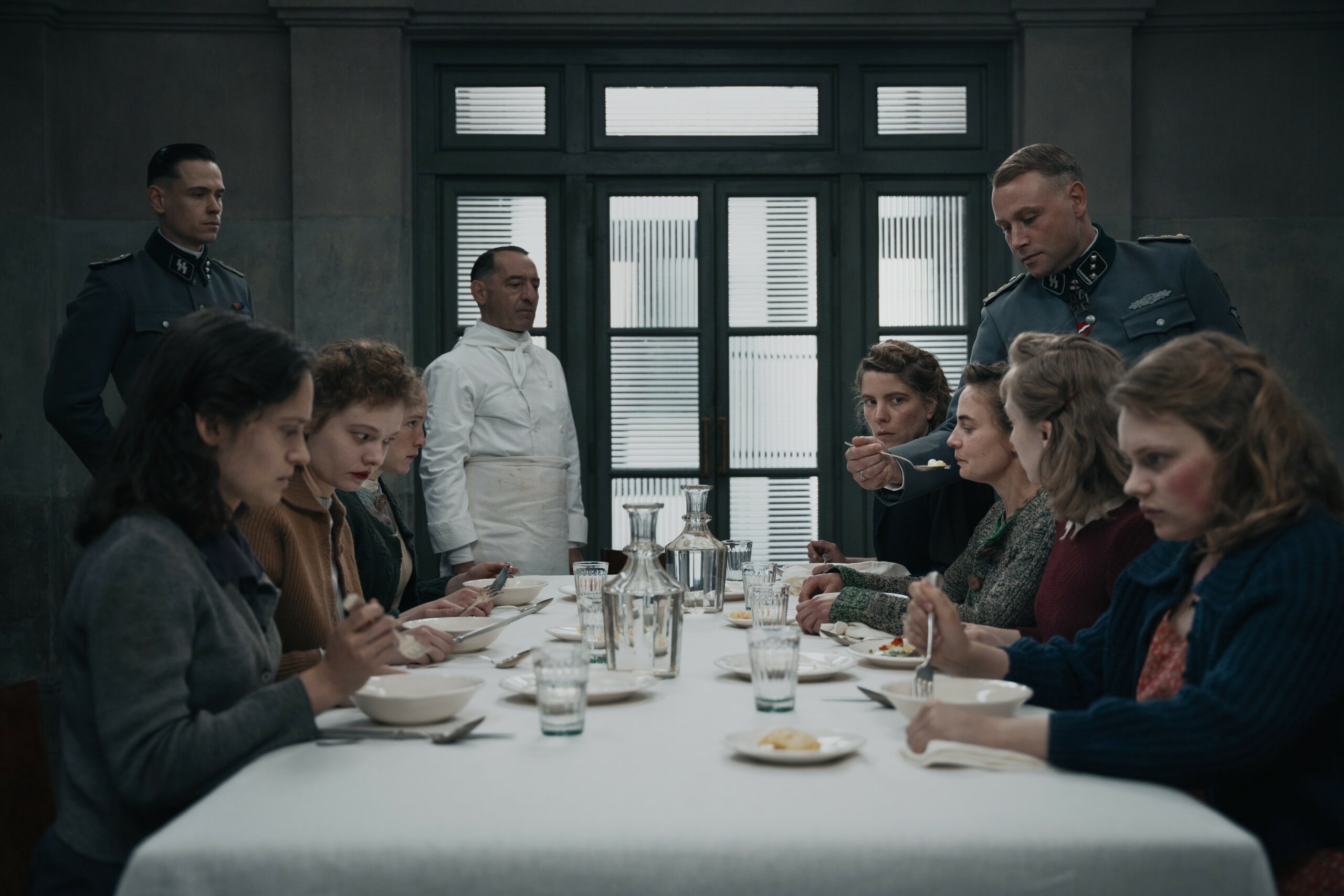
Italian director Silvio Soldini discusses bringing the remarkable true story behind his historical drama The Tasters to the screen. Adapted from At the Wolf’s Table and inspired by the testimony of Margot Wölk, the film follows a group of women forced to taste meals for Adolf Hitler to ensure they were not poisoned. The film arrives in UK and Irish cinemas on 13 March.
The film’s authenticity really struck me — the detail, the atmosphere, the cast. It genuinely feels like stepping into the 1940s. How did you achieve that level of realism?
I’m happy you say that because I was very worried it wouldn’t feel real. I actually hate many period films because everything looks fake — perfect smiles, everyone beautiful and polished. We wanted the opposite. We worked very carefully with the actresses, with makeup, costumes and the sets. The interior location was completely built by the production designers. They found an empty space and transformed it into what they imagined a German school occupied by the military might look like. With cinematography, costume and design, we constantly referred to photographs, paintings and historical images so that every choice had a precise direction.
When you read Rosella Postorino’s novel, what convinced you it could become a film rather than simply remaining a powerful book?
I don’t know if I was completely convinced at first, but I loved the way the story unfolded. The novel is written in the first person by Rosa and follows the relationships between these women over about a year. That fascinated me. My films often focus on female characters, and I enjoy working with actresses. This time, there were seven of them, which made the project irresistible. From the beginning, I also wanted German actresses. I don’t like it when films about a place are made with actors speaking another language. Even though these actresses didn’t live through that time, I believe the long wave of history reaches later generations. They felt they had something important to express.
You shot the film entirely in German, which isn’t your native language. How does working in another language affect the way you direct actors?
It’s actually not so different. Even if you don’t understand every word, you know what is happening in the scene. What matters is what you feel when you watch the actors. Of course, someone can tell you if a line was spoken incorrectly, but that’s a small problem. Sometimes working with people from another culture also brings something unexpected into the film, something that isn’t familiar to you.
Does that make you rely more on instinct and emotion rather than the precise meaning of the dialogue?
Yes, very much. I always ask myself what is happening in front of me. What do I feel when I watch them? Even if you don’t hear the exact words, you can see whether something real is happening. If you watch a performance without dialogue, you can still tell whether the actor is doing something truthful.
Some of the most tense moments in the film are the quiet scenes where the women wait after eating to see if the food is poisoned. What interested you about building tension in those smaller moments?
At the beginning, there is enormous tension, but it slowly changes as the women begin to get used to their situation. They start to believe that maybe nothing will happen. That’s why when something finally does happen, it becomes even more powerful. When Rosa and the others are poisoned, the scene becomes chaotic because nobody knows what to do, and it is also the moment when Rosa realises that Ziegler cannot protect her.
The group of actresses work beautifully together on screen. How did you create that sense of a real group dynamic?
I travelled to Berlin many times and auditioned many young actresses. I saw at least twenty for some roles. It’s always difficult because you sometimes want to work with several of them. The first time they were all together was when they arrived in northern Italy before filming. When we dressed them in costume and makeup and filmed some camera tests, suddenly it felt as if we had stepped into the past. None of them ever tried to outshine the others, and that gave the whole production a great creative energy.
Your films often focus on intimate human stories rather than spectacle. What attracts you to those kinds of narratives?
Human relationships fascinate me — how people behave and how characters change from one moment to another. It’s the same curiosity you have in life when you meet someone and try to understand who they really are.
Did you see this story purely as historical, or as something that speaks more broadly about human behaviour?
I didn’t want the film to remain locked in history. I wanted it to come toward us and say something about the present. That is what I try to do with every film I make.
What stayed with you most after making the film?
Working with those actresses. Their seriousness, and also the way they supported one another. None of them ever tried to dominate the others. When you manage to recreate a world that no longer exists and the actors believe in it with you, that’s something special.
The Tasters is released in UK and Irish cinemas from 13 March.

